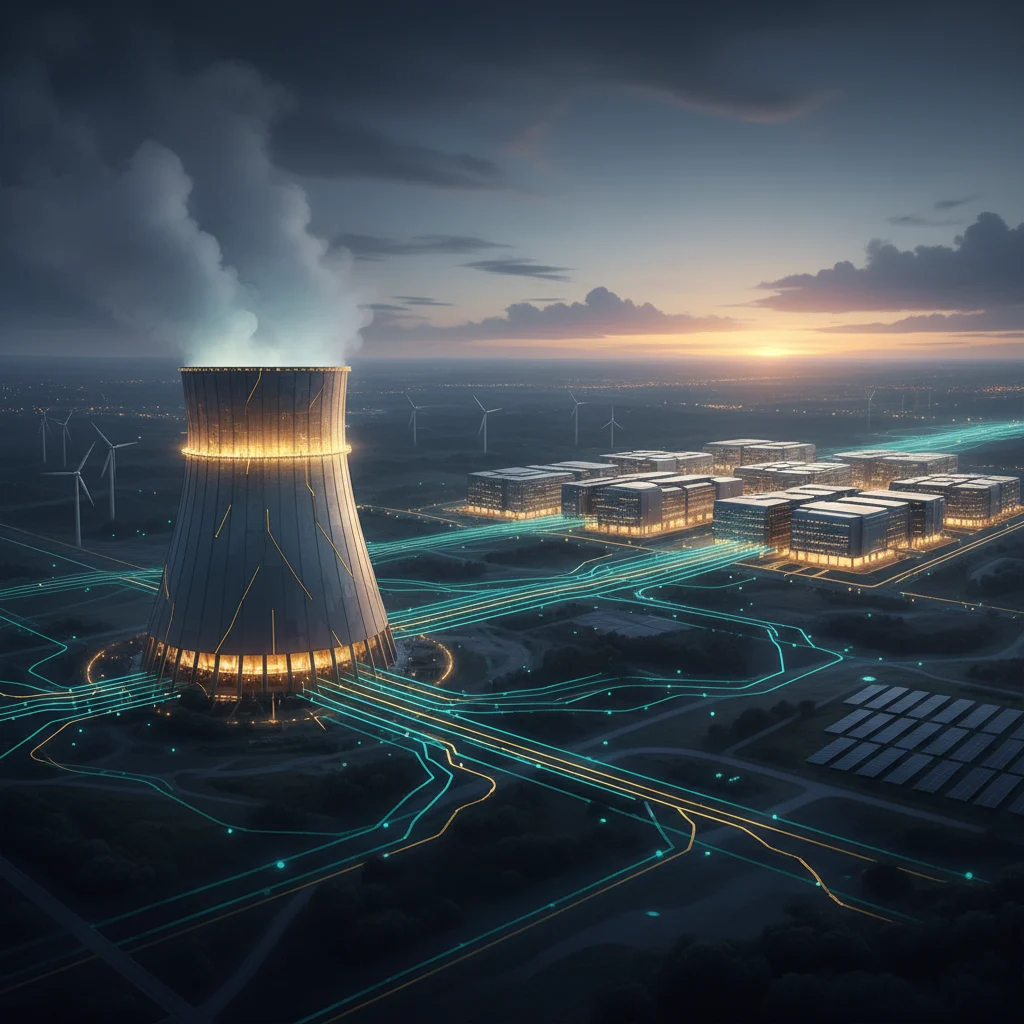
Quick answer: Data center stocks are companies tied to the physical and digital infrastructure that runs cloud computing and AI workloads — data-center operators and REITs, cloud hyperscalers, server makers, networking companies, power and electrical equipment makers, cooling specialists, and the utilities that feed them. As of May 30, 2026, Belanger Trading is watching this group because the AI trade is moving beyond chips into the buildout itself. But “second-layer AI” is not the same as safe. The job is to follow the spending — to find the companies turning AI demand into real orders, backlog, margins, contracts, and durable assets, not the ones simply being pulled up because they sound connected to AI.
Follow the spending, not the hype.
Last updated: May 30, 2026 — Belanger Trading updates this page as earnings, capex guidance, leasing activity, and valuations change. Market and earnings data as of May 30, 2026.
Why data centers matter to AI
The first thing most investors learned about the AI boom is that it runs on Nvidia chips. That is true, and it is also incomplete. A chip is not a product until it sits in a server, in a rack, in a building, plugged into power, kept cool, and wired to a network fast enough to feed it data. AI does not run on chips alone. It runs on data centers. Nvidia may be the obvious AI winner, but this page is about the infrastructure around the AI buildout.
An AI workload needs all of it at once:
- Compute — the chips and the servers built around them
- Networking — the switches and optics that move data between thousands of chips at once
- Power — electrical gear, transformers, switchgear, and ultimately a utility connection
- Cooling — the systems that pull heat out of racks now running hotter than any prior generation of hardware
- Physical facilities — the real estate, the shell, the land, and the grid access
- Cloud capacity — the platforms that rent all of the above out by the hour
Nvidia is the most visible winner in this stack. But every chip it sells sets off a chain of spending across the rest of the list. That chain is the data-center trade.
The layers of the stack
The simplest way to keep this group straight is to picture the buildout as a stack, from the silicon at the bottom to the electricity at the top. Each layer is a different business — and each company on this page lives in one of them:
- Chips and accelerators — the processors that do the AI math (the layer Nvidia dominates)
- Servers and systems — the boxes and racks that turn chips into working machines
- Networking and connectivity — the switches and optics that move data between thousands of chips at once
- Data-center operators and REITs — the buildings, land, and leases that house it all
- Power and electrical equipment — the transformers, switchgear, and grid connections that energize the racks
- Cooling and infrastructure — the thermal systems that keep hardware running hotter than ever from overheating
- Utilities and energy supply — the companies that generate the electricity feeding the whole stack
Read the page through this stack and the names stop blurring together. A networking company and a utility are both “data-center stocks,” but they sit at opposite ends of the buildout with completely different risks.
The AI trade is moving into the plumbing
Here is the framing worth keeping.
The first AI trade was chips. The next AI trade may be the plumbing.
Servers. Power. Networking. Cooling. Real estate. The unglamorous layer underneath the headline name. That is where the data-center story begins — and it is already showing up in the numbers, not just the narrative.
The reason is simple: the biggest buyers of AI infrastructure have told the market exactly how much they intend to spend. For calendar 2026, the largest hyperscalers — Microsoft, Amazon, Alphabet, and Meta — have guided to combined capital spending widely reported in the $700 billion-plus range, a sharp step up from 2025, with the bulk aimed at AI infrastructure (more here). That money does not stop at chips. It flows out to whoever builds, powers, cools, and connects the buildings those chips live in.
This is the same shift we flagged on our best stocks to buy now watchlist: the AI trade is broadening past the single headline name into the picks-and-shovels layer around it. This page is the deep version of that idea — the full data-center stack, bucket by bucket.
But broadening is not the same as safe. When a theme is this loud, valuations can run ahead of the cash flows, and “connected to AI” becomes a marketing line rather than a financial fact. The discipline that matters here is the one we apply to any watchlist: separate the company from the setup, and follow where real spending actually lands.
Types of data center stocks
Each layer of the stack is its own business with its own risk profile, and lumping them together is the first mistake. Here are the buckets mapped to representative names — what each one actually does in the buildout, and who plays in it.
| # | Bucket | What they do — and the AI angle | Representative names |
|---|---|---|---|
| 1 | Operators / REITs | Own and lease the buildings; the AI angle is leasing demand and pre-leased pipeline | EQIX, DLR |
| 2 | Cloud / hyperscalers | Buy and rent out the compute; they write the $700B+ capex checks the whole group depends on | AMZN, MSFT, GOOGL, META |
| 3 | Servers & hardware | Assemble chips into AI systems; most direct hardware play, but the thinnest margins | DELL, SMCI |
| 4 | Networking | Move data between thousands of chips at once; gets more valuable as clusters scale | ANET, AVGO |
| 5 | Power & electrical | Transformers, switchgear, and grid connections; you can’t energize compute without it | ETN, PWR |
| 6 | Cooling & infrastructure | Thermal management as racks run hotter and the industry shifts to liquid cooling | VRT |
| 7 | Utilities / energy | Generate the electricity; the bridge to the broader power story | CEG, VST |
The seventh bucket is the hand-off point. Power demand from data centers is reviving interest in utilities and independent power producers, but the generation story — nuclear, uranium, small reactors — is deep enough to deserve its own page, so we send that to nuclear energy stocks and keep this page on the data-center stack itself.
Representative names worth watching
These names were chosen because the AI-infrastructure demand is showing up in their actual reported numbers — not because they sound like AI. Every figure carries a source and an as-of date. This is a research watchlist, not a list of buy orders, and each name has a real risk attached.
To keep the page from reading like an encyclopedia, we sort the names into three groups:
- Core Watch Names — the most direct second-layer plays, where the order books and backlogs give the clearest read on real AI-infrastructure demand.
- Secondary Watch Names — real exposure too, but more diluted, more concentrated, or carrying a sharper-than-average risk (including the page’s clearest margin cautionary tale).
- Context Names — the chip leader and the hyperscalers. They define and fund the trade, but they are not the subject of this page; we treat them as backdrop, not buy ideas.
Core Watch Names
The four names where AI-infrastructure demand shows up most directly in the numbers.
EQIX — Equinix (operators / REITs)
What it does. Equinix is the largest data-center interconnection company, operating a global network of facilities where companies house equipment and connect directly to clouds, networks, and each other.
Why it’s on the list. The leasing demand is real and accelerating. In Q1 2026 (reported April 29, 2026), Equinix posted revenue of $2.444 billion, up 10% year over year, AFFO of $1.065 billion (up 12%), and record bookings with a rapid uptick in AI-related deals. It raised full-year 2026 AFFO-per-share guidance to roughly $42.31–$43.11. Record bookings with a growing AI deal mix is exactly the kind of forward visibility that separates real demand from a story.
The risk. EQIX is a REIT, which means it is rate-sensitive: when long-term rates rise, the shares tend to fall regardless of how the business is doing. It also trades at a premium, and building capacity is capital-intensive — growth costs money up front before the leases pay off.
DLR — Digital Realty (operators / REITs)
What it does. Digital Realty owns and operates data centers worldwide, leasing space and power to hyperscalers and enterprises, with a large interconnection business alongside the real estate.
Why it’s on the list. The backlog tells the story. In Q1 2026 (reported April 23, 2026), Digital Realty reported revenue up 16% to $1.64 billion, core FFO of $2.04 per share, a signed backlog of $1.8 billion at 100% share, and 1.2 gigawatts under construction — up over 50% sequentially and 61% pre-leased. It signed a 200-megawatt AI-oriented lease with a hyperscaler in Charlotte, its largest ever, and raised 2026 core-FFO guidance to $8.00–$8.10.
The risk. Same rate sensitivity as any REIT, plus a heavier reliance on a handful of giant hyperscaler tenants. Big pre-leased pipelines are a strength until a major customer slows its buildout — concentration cuts both ways.
ETN — Eaton (power & electrical)
What it does. Eaton makes electrical equipment — power distribution, switchgear, and the systems that energize buildings — and data centers have become one of its fastest-growing markets.
Why it’s on the list. This is the bottleneck made visible. In Q1 2026 (reported May 5, 2026), Eaton posted record revenue of $7.5 billion (up 17%), with data center orders up about 240% year over year and total Electrical backlog up 48%. Management framed the data-center pipeline as years of visibility at current build rates. It raised full-year organic growth guidance to 9–11%. You cannot power a gigawatt of AI compute without this gear, and the order book shows it.
The risk. Eaton is a diversified industrial — data centers are a large and growing slice, not the whole company, so the AI story is partly diluted by aerospace, vehicle, and other end markets. A capex slowdown among the hyperscalers would show up in those eye-catching order numbers first.
VRT — Vertiv (cooling & infrastructure)
What it does. Vertiv makes the power and cooling infrastructure that goes inside data centers — thermal management, including liquid cooling, plus power systems and racks. It is one of the cleaner pure-play ways to own the physical buildout.
Why it’s on the list. As AI racks run hotter, cooling moves from afterthought to bottleneck — and Vertiv’s order book reflects it. In Q1 2026 (reported April 22, 2026), Vertiv posted net sales up 30% year over year to $2.65 billion, a record backlog of about $15 billion, and a book-to-bill ratio around 2.9x. It raised full-year 2026 guidance to $13.5–$14.0 billion in net sales. A book-to-bill well above 1.0 means orders are coming in far faster than the company can ship them — the kind of demand signal that is hard to fake.
The risk. Vertiv is the most concentrated bet on the page — its fortunes are tied tightly to data-center capex, so if the hyperscalers pull back, there is no other business to cushion it. The stock has run hard on the cooling theme, and a premium valuation built on a 2.9x book-to-bill assumes that pace holds. The most direct exposure carries the most direct downside.
Secondary Watch Names
Real exposure, but with more dilution, more concentration, or a sharper risk — including the page’s clearest margin cautionary tale.
DELL — Dell Technologies (servers & hardware)
What it does. Dell builds servers, storage, and PCs, and its Infrastructure Solutions Group has become a leading supplier of AI-optimized servers built around Nvidia and other accelerators.
Why it’s on the list. This is where the buildout becomes physical, in dollars. In its fiscal Q1 2027 (reported May 28, 2026), Dell reported record revenue of $43.8 billion, up about 88% year over year, booked $24.4 billion in AI orders, recognized $16.1 billion of AI server revenue, and ended the quarter with a record $51.3 billion AI backlog. It raised full-year AI-server revenue guidance to roughly $60 billion and lifted total revenue guidance to $165–$169 billion (results via SEC 8-K).
The risk. Margins. Assembling other companies’ chips into servers is a lower-margin business than designing the chips, so a backlog measured in the tens of billions converts to far thinner profit than the headline revenue implies. Watch operating margin and the mix, not just the top line — and remember much of that backlog rests on a few hyperscaler customers.
SMCI — Super Micro Computer (servers & hardware)
What it does. Super Micro builds high-density servers and full rack systems optimized for AI, and was an early mover in liquid-cooled AI hardware.
Why it’s on the list — and why it’s the cautionary tale. SMCI shows both sides of the server trade at once. In its fiscal Q3 2026 (reported May 5, 2026), revenue jumped about 123% year over year to $10.24 billion, with AI GPU platforms making up over 80% of revenue and a record backlog — but gross margin was only about 10.1%. Management raised full-year FY2026 revenue guidance to $38.9–$40.4 billion. Explosive demand, razor-thin margins: that is the server bucket in one company.
The risk. A double-digit-percent gross margin is fragile. Pricing pressure, component costs, and customer mix can swing profitability fast, and the stock carries a history of volatility and an accounting cloud from prior years. High revenue growth does not guarantee high-quality earnings — this name is the clearest reminder on the page that revenue is not the same as margin.
ANET — Arista Networks (networking)
What it does. Arista makes high-performance networking switches and software used to wire together large cloud and AI clusters, selling heavily to the hyperscalers.
Why it’s on the list. As AI clusters scale, the network connecting the chips becomes a bottleneck — and Arista’s results reflect it. In Q1 2026 (reported May 5, 2026), Arista posted revenue of $2.709 billion, up 35.1% year over year, with non-GAAP gross margin of 62.4%. Management guided 2026 revenue growth to about 27.7% (roughly $11.5 billion) and lifted its AI revenue target to $3.5 billion (details). Unlike the server makers, this is a high-margin business — the networking layer keeps more of each dollar.
The risk. Customer concentration is real: a large share of revenue comes from a small number of hyperscalers, so one customer’s pause hits hard. Management also flagged that demand is outstripping supply across components, which can cap how fast it grows, and a premium valuation leaves little room for a miss.
AVGO — Broadcom (networking)
What it does. Broadcom makes custom AI chips and networking silicon for the largest cloud companies, and owns VMware on the software side. On our watchlist it sits in the AI-infrastructure slot, and the networking piece is core to the data-center stack.
Why it’s on the list. Broadcom sells a lot of the connective tissue around the AI engine. In fiscal Q1 2026, it reported total revenue of $19.31 billion, with AI semiconductor revenue of $8.4 billion, up 106% year over year, and management pointed to a roughly $73 billion AI order backlog with a line of sight to AI chip revenue above $100 billion in 2027. We cover the full Broadcom case on our best stocks to buy now page.
The risk. The same customer concentration that powers the backlog can shrink it fast — Broadcom’s AI growth leans on a small group of giant customers building their own chips. A premium valuation assumes the 2027 targets land.
PWR — Quanta Services (power & electrical infrastructure)
What it does. Quanta is an infrastructure construction company that builds and upgrades electric power systems — transmission, distribution, grid modernization, and increasingly the electrical work that connects data centers to power.
Why it’s on the list. Data centers do not just need equipment; someone has to build the grid connections. In Q1 2026 (reported April 30, 2026), Quanta reported record revenue of $7.87 billion (up from $6.23 billion a year earlier) and a record backlog of $48.5 billion, driven in part by data center infrastructure demand. It raised full-year 2026 revenue guidance to $34.7–$35.2 billion. The backlog is the durable-demand signal here.
The risk. Construction is a project business — it carries execution, labor-availability, and margin risk, and a chunk of the backlog is tied to power and renewables broadly, not data centers alone. The grid-buildout thesis is real, but it is lumpier than a recurring-revenue model.
CEG and VST — the power bridge (utilities / energy)
The seventh bucket — the companies that generate the electricity — is where the data-center trade hands off to the power trade. Constellation Energy (CEG) is the largest U.S. nuclear operator and has signed standout deals to sell carbon-free power directly to data centers; on our best stocks to buy now watchlist we flag it as a “wait for a pullback” name, because the AI-power story is real but the stock has run hard and trades at a premium to utility peers. Vistra (VST) is an independent power producer that has signed long-term nuclear power agreements tied to data-center demand, including deals with Meta and Amazon Web Services.
We keep this light on purpose. The power-generation layer — nuclear operators, uranium, small modular reactors, the utilities benefiting from rising demand — is a full story of its own. That is the nuclear energy stocks page. Here, treat CEG and VST as the bridge: the point where “AI needs data centers” becomes “data centers need power.”
Context Names
These names define and fund the trade, but they are not what this page is about. We reference them for context and cover them in depth elsewhere.
Nvidia (NVDA) is the chip leader at the bottom of the stack — the obvious AI winner. But this page is about the infrastructure around the AI buildout, not the chip itself, so we do not re-litigate the Nvidia case here. We cover it on our best stocks to buy now watchlist and on the Nvidia earnings page.
The hyperscalers — Amazon, Microsoft, Alphabet, and Meta — are the cloud layer that writes the checks. Their combined $700 billion-plus in 2026 capital spending is the single force underwriting every other name above. But each is a mega-cap with a huge base business, so the AI-infrastructure signal is diluted across search, advertising, retail, and software. They matter here as the demand source, not as a focused way to own the buildout.
The Belanger Take
The data-center trade is one of the clearest second-layer AI trades. But second-layer does not mean safe. Belanger Trading is watching where AI infrastructure demand shows up in orders, backlog, pricing power, margins, contracts, and power constraints.
The spending is real, it is enormous, and it is already showing up in numbers that give unusual visibility — Vertiv’s 2.9x book-to-bill, Eaton’s 240% jump in data-center orders, Digital Realty’s pre-leased gigawatts, Dell’s $51 billion AI backlog. This is not a vibe. It is a buildout.
The risk is that investors start treating every data-center-related company like an AI winner. Some companies will convert demand into revenue and margins. Others may simply get pulled higher by the theme. The difference is everything, and it does not show up in a one-line pitch. It shows up in the numbers: Is the backlog growing or just large? Is the margin holding, or is the company buying revenue at a thin spread the way a server assembler does? Is the demand contracted for years, or could a single hyperscaler’s capex decision erase it?
That is why we frame the buckets separately. A data-center REIT, a server maker, a networking company, and an electrical-equipment maker are four different businesses with four different risks. Treating them as one trade — “AI needs data centers, buy everything” — is how investors overpay for the theme and underprice the risk.
The story is not “buy the buildout.” The story is follow the spending. Watch where the hyperscaler capex actually lands, which companies turn it into durable backlog and defensible margin, and which are just standing near the trade. That is the work.
What could go wrong
This is a crowded, richly valued theme, and the risks are not hypothetical:
- Valuations get stretched. Several of these names trade at premiums that already price in years of growth. A great business at an indefensible price is still a poor entry.
- AI capex slows. The entire trade rests on hyperscaler spending. If Microsoft, Amazon, Alphabet, or Meta signal restraint, the order books that look bulletproof today can soften quickly.
- Hyperscalers overbuild. A burst of capacity built ahead of demand can lead to a digestion period where orders pause even if long-term demand is intact.
- Power and cooling constraints. The bottlenecks that make some of these companies valuable can also cap how fast the whole buildout proceeds — you cannot energize compute you cannot power or cool.
- Margin pressure. Especially in servers, revenue growth and profit growth are not the same thing. SMCI’s roughly 10% gross margin is the reminder.
- Customer concentration. Networking and custom-silicon names lean on a handful of giant buyers. One customer’s pause hits hard.
- Rate sensitivity for REITs. EQIX and DLR fall when long-term rates rise, regardless of leasing strength.
- Financing and supply-chain costs. Capital-intensive buildouts are exposed to higher financing costs and component shortages — Arista has already flagged supply outstripping demand across parts.
- Regulatory and environmental pushback. Power demand, water use for cooling, and grid strain are drawing scrutiny in some markets.
What to watch next
The signals that tell you whether this trade is strengthening or cracking:
- Hyperscaler capex guidance. The single most important number for the whole group. Rising guidance underwrites the trade; restraint is the warning.
- Backlog and book-to-bill. Growing backlogs and book-to-bill above 1.0 (Vertiv, Eaton, Quanta, Digital Realty) mean demand is still outrunning supply.
- Data-center leasing activity. New signed leases and pre-leasing rates at the REITs.
- Power availability and utility deals. New power-purchase agreements and grid connections — the bottleneck to watch.
- Margins, not just revenue. Especially in servers, watch whether profit grows with the top line.
- Networking and cooling orders. The clearest read on how fast clusters are scaling.
- Cloud growth rates. AWS, Azure, and Google Cloud growth show whether the demand at the top of the chain is holding.
- AI workload monetization. Ultimately, the buildout has to pay for itself — watch whether AI revenue at the hyperscalers justifies the spend.
How investors can use this list
Data center stocks are not one trade, and the most useful thing this page can do is stop you from treating them like one.
- Pick your layer first. A REIT (rate-sensitive, income-like), a hyperscaler (mega-cap, AI diluted by a huge base business), a server maker (high revenue, thin margin), a networking name (high margin, concentrated), an electrical or cooling supplier (bottleneck play, capex-dependent) — these are genuinely different risk profiles. Decide which one fits what you’re trying to do before you chase the theme.
- This is research, not advice. Nothing here is a recommendation to buy a specific stock for your situation. Every name has a real, specific risk attached, spelled out above. Use the list to decide what to study.
- Separate the company from the setup. A strong business can be a poor entry after a big run. The time to do the work and decide your level is before the next pullback, not after.
- Follow the spending, not the hype. When you’re deciding whether a name belongs on your own watchlist, the test is the same one we use: is the AI demand showing up in this company’s orders, backlog, margins, and contracts — or just in its story?
AI is moving beyond chips. Data centers are where the AI buildout becomes physical. But investors still need to follow real spending, real orders, real margins, and real constraints.
Every great trade or investment starts with deep research. Treat the layers and names above as the start of yours.
Frequently asked questions
What are data center stocks? Data center stocks are companies tied to the infrastructure that runs cloud computing and AI workloads. The group spans seven buckets: data-center operators and REITs (EQIX, DLR), cloud hyperscalers (AMZN, MSFT, GOOGL, META), server and hardware makers (DELL, SMCI), networking companies (ANET, AVGO), power and electrical equipment makers (ETN, PWR), cooling and infrastructure specialists (VRT), and the utilities that generate the power (CEG, VST). They are not one trade — each bucket carries a different risk profile.
Why are data center stocks tied to AI? Because AI cannot run on chips alone. Every Nvidia chip needs a server to sit in, a building to house it, power to run it, cooling to keep it from overheating, and networking to feed it data. As the largest cloud companies pour a combined $700 billion-plus into AI infrastructure in 2026, that spending flows out across the entire data-center stack — making these companies a second-layer way to play AI demand.
What companies benefit from data-center growth? Representative names across the buckets include Equinix and Digital Realty (REITs), Amazon, Microsoft, Alphabet and Meta (hyperscalers), Dell and Super Micro (servers), Arista and Broadcom (networking), Eaton and Quanta Services (power and electrical), Vertiv (cooling), and Constellation Energy and Vistra (power generation). The ones worth watching are those turning AI demand into real backlog, margins, and contracts — not just companies that sound connected to AI.
Are data center REITs good AI investments? REITs like Equinix and Digital Realty give direct exposure to leasing demand — Equinix posted record bookings and Digital Realty a record backlog, both with growing pre-leased pipelines, in Q1 2026. But as REITs they are rate-sensitive: when long-term rates rise, the shares tend to fall regardless of leasing strength, and they trade at premiums. An income-flavored, rate-exposed way to own the buildout, not a high-growth one.
What risks do data center stocks face? Stretched valuations, a slowdown in hyperscaler capex, overbuilding, power and cooling constraints, thin margins (especially in servers), customer concentration in networking and custom silicon, rate sensitivity for REITs, financing and supply-chain costs, and regulatory pushback over power and water use. The biggest single risk is that the AI capex underwriting the whole trade slows.
How does power demand affect data centers? Power is the central bottleneck — a data center cannot run compute it cannot power or cool. That is why electrical-equipment makers (Eaton), grid builders (Quanta), cooling specialists (Vertiv), and power generators (Constellation Energy, Vistra) are now part of the AI trade. We cover the generation side separately on our nuclear energy stocks page.
Are data center stocks overvalued? Some are richly valued, and the theme is crowded. Several names trade at premiums that already assume years of growth, and a few have run hard on the AI narrative. That does not make the buildout fake — the backlogs and order books are real — but it does mean a strong company can be a poor entry at the wrong price. The discipline is to separate the business from the stock’s price and decide your level before chasing.
What should investors watch next? Hyperscaler capex guidance above all — it underwrites the entire trade. Then backlog and book-to-bill ratios, data-center leasing activity, new power deals, margins (not just revenue), networking and cooling orders, cloud growth rates, and whether AI workloads are generating enough revenue to justify the spending.
Get the AI Infrastructure Briefing
AI is moving beyond chips. The buildout is becoming physical — in servers, networking, power, and cooling — and the spending is showing up in real backlogs and order books.
Belanger Trading tracks the stock ideas, market warnings, and research investors and traders should be watching. Get the AI Infrastructure Briefing and see what we’re watching, and why. Get the free Belanger Trading briefing → No cost, unsubscribe anytime.
See also
- Best stocks to buy now — our broader watchlist, including the AI leaders behind this trade
- Nuclear energy stocks — the AI power-demand trade, and the generation layer this page hands off to
- Nvidia earnings — the chip leader whose results set the tone for the whole AI buildout
- Cheap stocks to buy now — beaten-down names worth a closer look
Sources
- Hyperscaler 2026 capex (~$700B+ combined across Microsoft, Amazon, Alphabet, Meta) — Tom’s Hardware, 2026; CNBC, Feb 6, 2026
- Equinix (EQIX) Q1 2026 results, AFFO, record bookings, raised guidance — StockTitan, April 29, 2026
- Digital Realty (DLR) Q1 2026 results, $1.8B backlog, 1.2 GW pipeline, raised core-FFO guidance — TIKR, 2026
- Dell (DELL) fiscal Q1 2027 results, $24.4B AI orders, $16.1B AI server revenue, $51.3B AI backlog, raised guidance — Yahoo Finance, May 28, 2026; StockTitan / SEC 8-K, May 28, 2026
- Super Micro (SMCI) fiscal Q3 2026 results, ~123% revenue growth, ~10.1% gross margin, raised guidance — CNBC, May 5, 2026
- Arista (ANET) Q1 2026 results, $2.709B revenue, 62.4% non-GAAP gross margin, 2026 guidance and AI target — Arista investor relations, May 5, 2026; Seeking Alpha, 2026
- Broadcom (AVGO) fiscal Q1 2026 AI revenue and backlog — FinancialContent, March 2026; TIKR
- Eaton (ETN) Q1 2026 results, data-center orders +240%, Electrical backlog +48%, raised guidance — The Motley Fool transcript, May 5, 2026
- Quanta Services (PWR) Q1 2026 results, $7.87B revenue, $48.5B record backlog, raised guidance — The Globe and Mail, April 30, 2026
- Vertiv (VRT) Q1 2026 results, +30% net sales, ~$15B backlog, ~2.9x book-to-bill, raised guidance — Alphastreet, April 22, 2026
- Vistra (VST) long-term nuclear power agreements tied to data-center demand (Meta, AWS) — Sahm Capital, Jan 21, 2026